Energy Label
The technological developments of recent years have led to more and more products being labeled A+ or better. Consequently, the label has lost much of its usefulness as a buying aid. Other conditions, such as user behaviour, have also changed. Therefore, the energy label was revised on 1 March 2021 for washing machines, dishwashers, refrigeration appliances and wine coolers: the plus classes (e.g. A+++) were discontinued and the scale now runs from A to G. New measurement methods for energy consumption and for determining the energy-efficiency class were also introduced. The QR code links to an EU database where you can view and download product datasheets. From 1 January 2027 the new energy label will also apply to tumble dryers. One of the most important new features is the introduction of a repairability class: it ranges from A (very easy to repair) to E (poor) and assesses, among other things, ease of disassembly and the availability of spare parts and repair instructions.For clearer reflection of your appliance efficiency
Technological development over the past few years has resulted in a higher concentration of products that carry labels with a value of A++ or better. Consequently, the label has not been fulfilling its original function as an aid for making purchasing decisions as well as it formerly did. Other basic conditions like user behaviour have also changed. That’s why the existing energy labels were adapted. Some home appliances (such as washing machines, washer-dryers, dishwashers, cooling appliances and wine coolers) had a new energy label as of March 1, 2021, while the label for tumble dryers was adapted as of July 1, 2025. These appliances must show the new label when sold in shops, online, etc. The most significant change in the new energy labels is the elimination of the energy efficiency plus classes, for example A+++. With the new energy labels, classification is from A to G. For washing machines, washer-dryers, dishwashers, cooling appliances and wine coolers, new methods of measuring energy consumption and determining the label class are used. For tumble dryers, new calculation methods are used to determine the energy efficiency classes. In addition, you can retrieve further product information directly via a QR code that is displayed on the Energy Label. The QR code forwards you to a database operated by the EU where you can view and download data sheets for all appliances that require the new energy label. Access to the database is also possible via the Internet.Washing machines
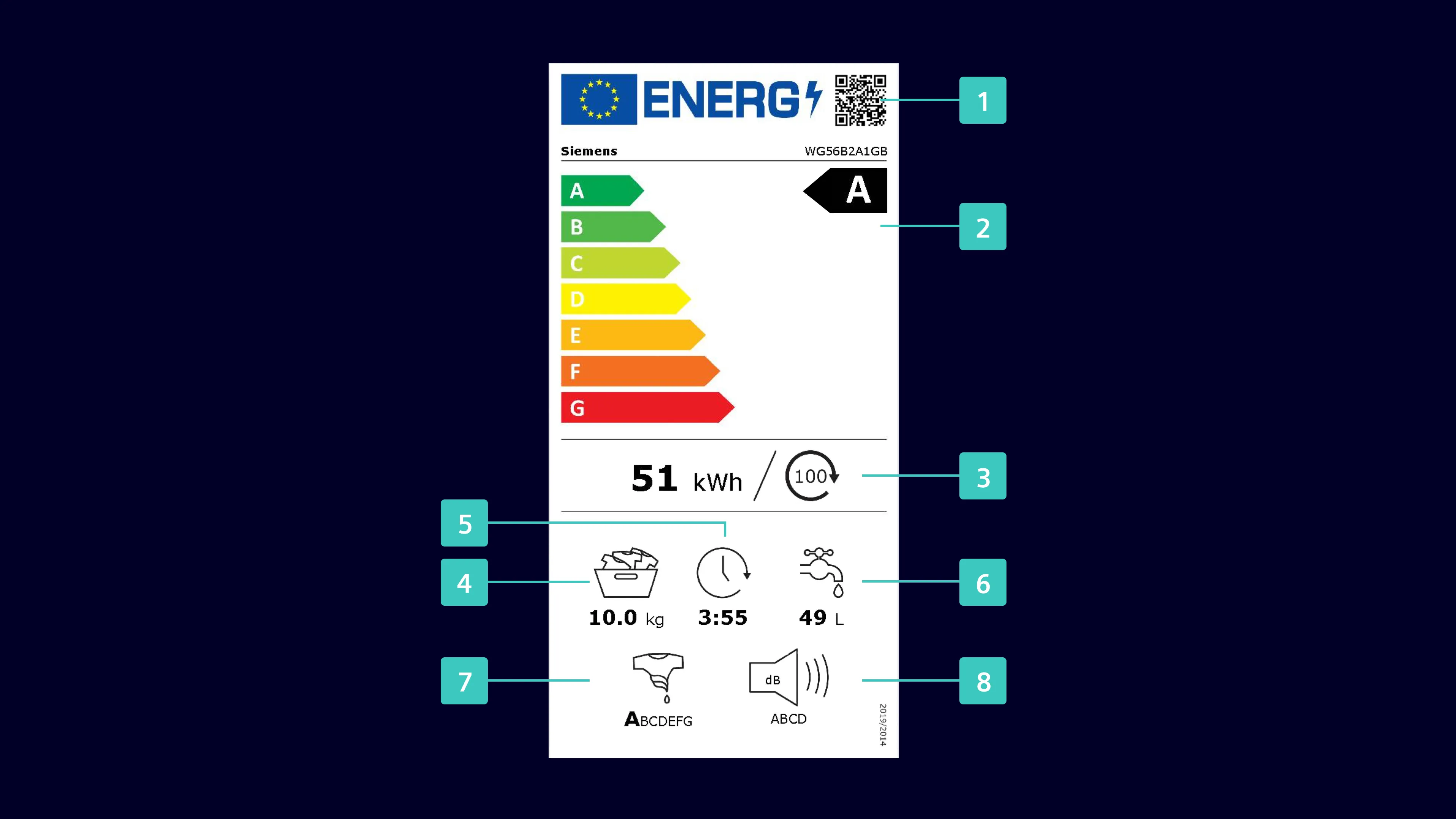
One of the major changes in the Energy Label for washing machines is the change in the test program to which all label values refer. Like for example the energy consumption which will be based on 100 wash cycles. The new “Eco 40-60”* program is suitable for cleaning normally soiled fabrics made of cotton, linen or mixed fibres which, based on their care symbol, are washable at 40°C or 60°C. The fabrics named may be combined in this wash cycle. The “Eco 40-60” program is the most efficient program in the combination “energy and water consumption”.
1 QR code
2 Energy efficiency class**
3 Weighted energy consumption** in kWh/100 operating cycles (in Eco 40-60 program)
4 Maximum load capacity
5 Duration of “Eco 40-60” program
6 Weighted water consumption** in liters/operating cycle (in Eco 40-60 program)
7 Spin efficiency class**
8 Noise emissions during spin cycle expressed in dB(A) re 1 PW and noise emission class**
* Eco 40-60: In order to achieve optimal energy efficiency, an optimal washing temperature is defined for this programme. This temperature can’t be changed by the customer. The actual washing temperature is specified in the user manual and, depending on the load size, may deviate from the selected washing temperature for reasons of saving energy. Washing performance complies with legal requirements.
** Values apply to quarter, half and full loads.
Washer Dryers
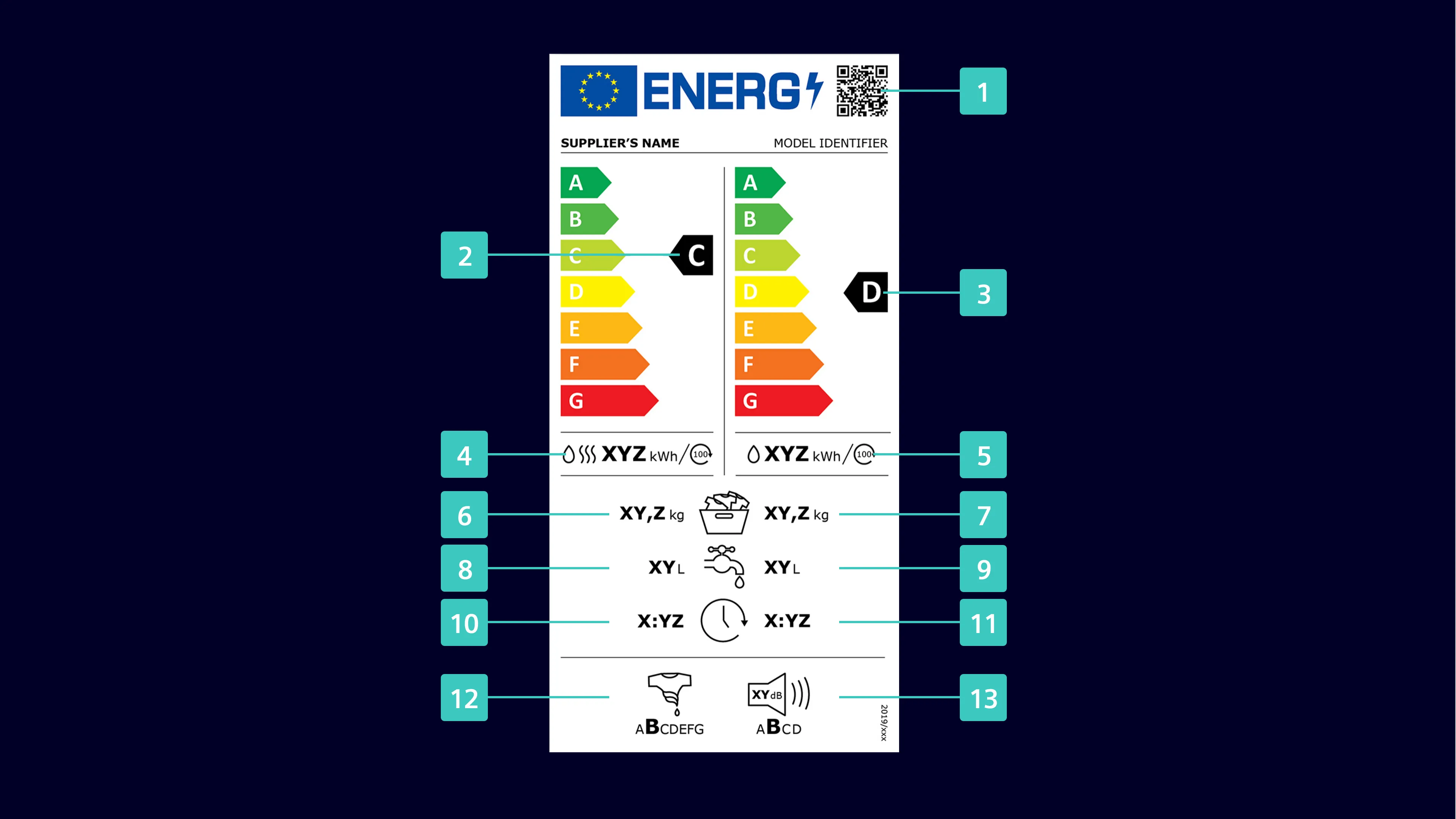
The current Energy Label for washer-dryers has not been revised since it was first introduced in 1996, which is why it still shows the original scale of A to G. Because washer-dryers are more frequently used just for washing, the label is divided into two parts. The left side of the label specifies the values for the complete “wash and dry” operating cycle. The right side of the label shows the values for the wash cycle alone. The values to be specified on this label for the wash cycle alone reflect the changes in mandatory information for the new washing machine label.
1 QR code
2 Energy efficiency class* (complete operating cycle)
3 Energy efficiency class* (wash cycle)
4 Weighted energy consumption* in kWh/100 cycles (complete operating cycle**)
5 Weighted energy consumption* in kWh/100 cycles (wash cycle)
6 Maximum load capacity (complete operating cycle**)
7 Maximum load capacity (wash cycle)
8 Weighted water consumption* in liters/operating cycle (complete operating cycle**)
9 Weighted water consumption* in liters/operating cycle (wash cycle)
10 Program duration (complete operating cycle)
11 Duration of “Eco 40-60” program
12 Spin efficiency class*
13 Noise emissions during spin cycle expressed in dB(A) re 1 PW and noise emission class
* Values apply to washing quarter, half and full load. While washing and drying to half and full load.
** Wash and dry
Dryers
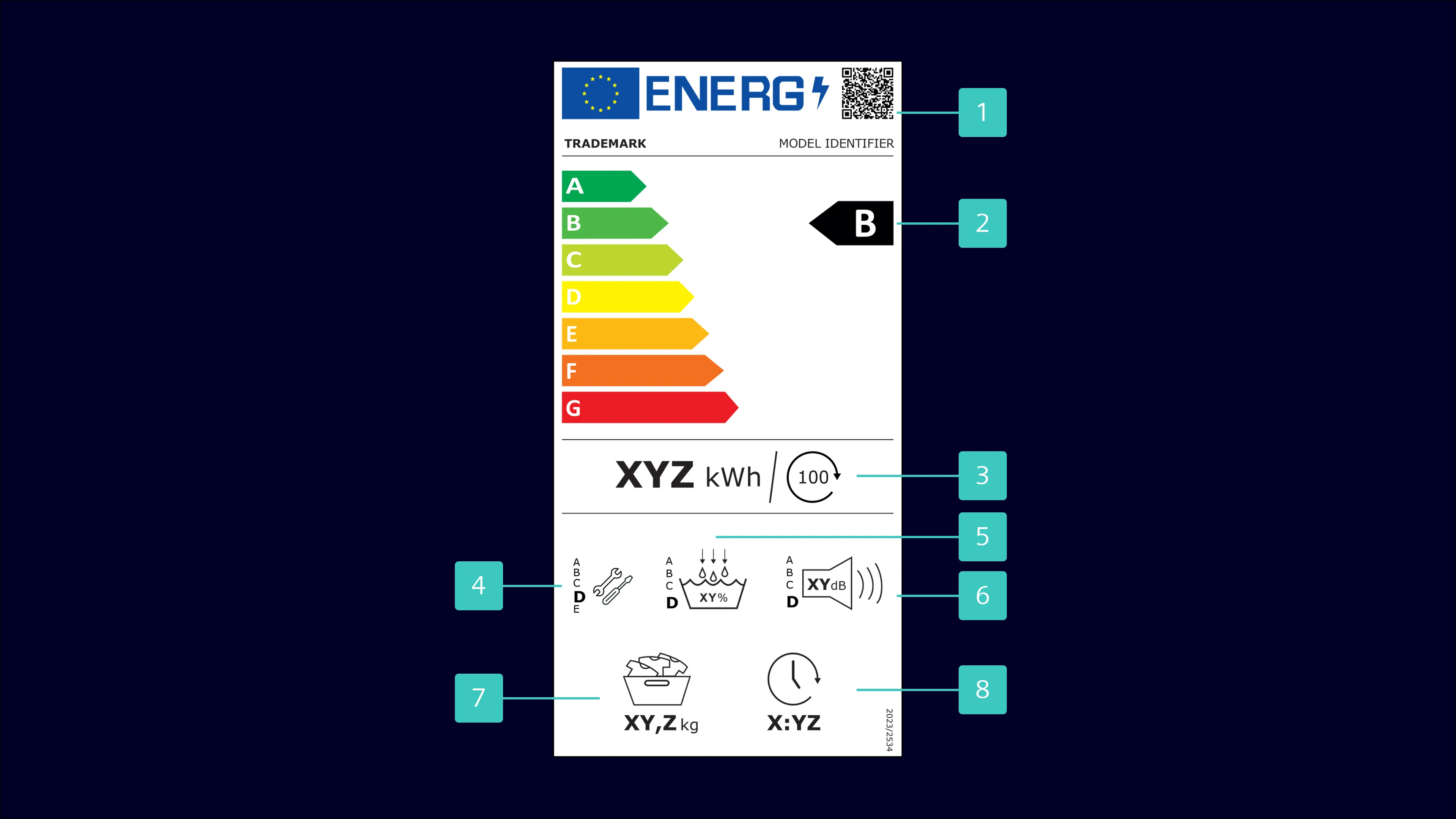
The energy label for tumble dryers will have a new, simplified design. The most important change is the revision of the energy-efficiency classes: the old A+++–D scale is replaced by a clear A–G scale.
Measurements on the label are still based on the proven eco program, but updated calculation methods now show energy consumption per 100 drying cycles rather than per year, making it easier to understand.
In addition, noise classes A–D supplement the familiar dB value to simplify loudness comparisons, and requirements for condensation efficiency have been tightened. The label also introduces a repairability class (A = very easy to repair, E = poor) that indicates how easy a device is to repair; evaluation covers factors such as ease of disassembly, availability of spare parts and the provision of repair instructions.
1 QR code linking to the EU product database
2 Energy efficiency class (A–G)
3 Energy consumption in kWh per 100 drying cycles*
4 Repairability class (A–E)
5 Condensation efficiency class (A–D)
6 Noise emission class (A–D) and noise value in dB(A)**
7 Maximum load capacity (rated capacity in kg)**
8 Program duration in hours and minutes [h:min]**
*Values apply to the weighted average of half and full loads with a ratio of 0.62 (24 × full load, 76 × half load).
** Drying cycle of the eco program at full load.
Dishwashers
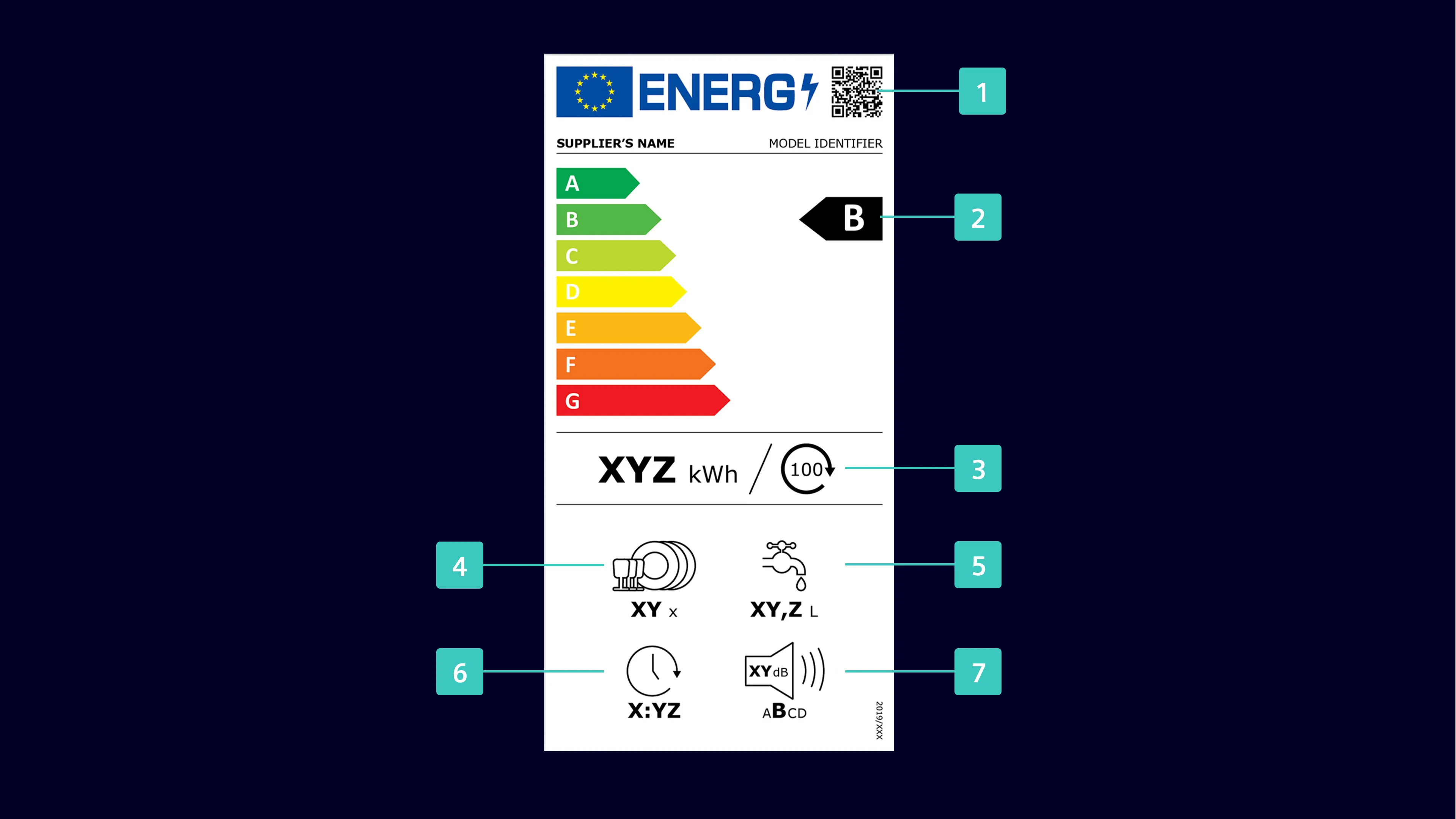
The energy efficiency class for dishwashers is based on the “Eco” program and the EU Regulation for energy efficiency classes. For example, cups, pots and plastic utensils are used to determine cleaning and drying performance. The Eco 50°C program is ideal for normally soiled dishes and is the most efficient program regarding energy and water consumption. As with washing machines and tumble dryers the energy consumption is based on 100 cleaning cycles.
1 QR code
2 Energy efficiency class
3 Energy consumption in kWh/100 operating cycles (in Eco program)
4 Number of standard place settings for the Eco program
5 Water consumption in litres/operating cycle (in Eco program)
6 Duration of the “Eco” program
7 Noise emissions expressed in (dB(A) re 1 PW) and noise emission class
Fridges and freezers
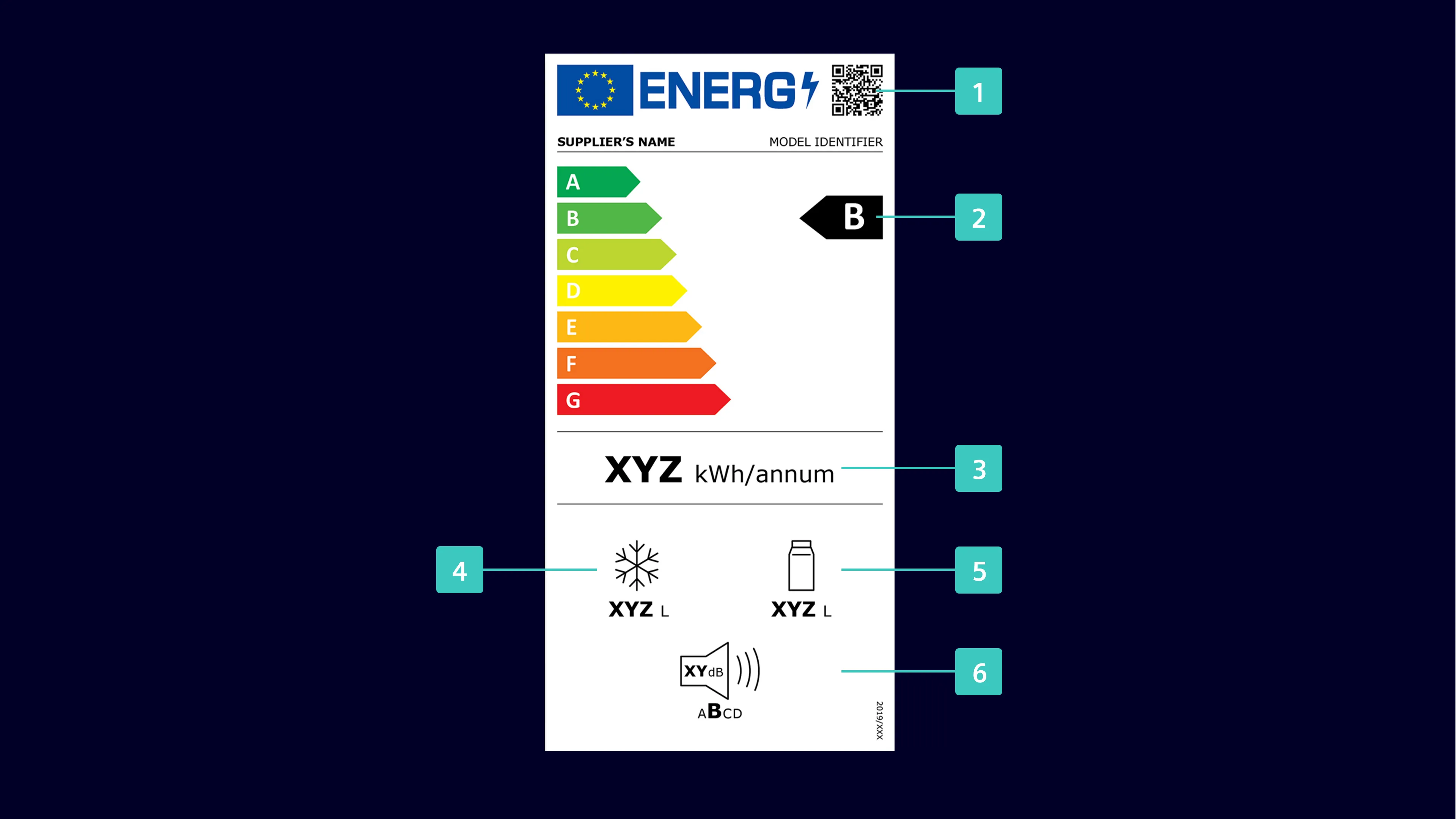
The energy efficiency class is determined by a comprehensive procedure that takes into account the appliance's type, its operating principle, the ambient room temperature, as well as the number and size of the storage compartments. In addition to this classification, the energy label specifies the annual energy consumption in kWh (“annum”). It also provides clear information on the total volume of all refrigerator and freezer compartments and details the appliance's noise emissions and its corresponding noise emission class.
1 QR code
2 Energy efficiency class
3 Energy consumption in kWh/year (measured under new standard conditions)
4 Total volume of all freezer compartments
5 Total volume of all refrigerator compartments
6 Noise emissions expressed in dB(A) re 1 PW and noise emission class
Wine Coolers
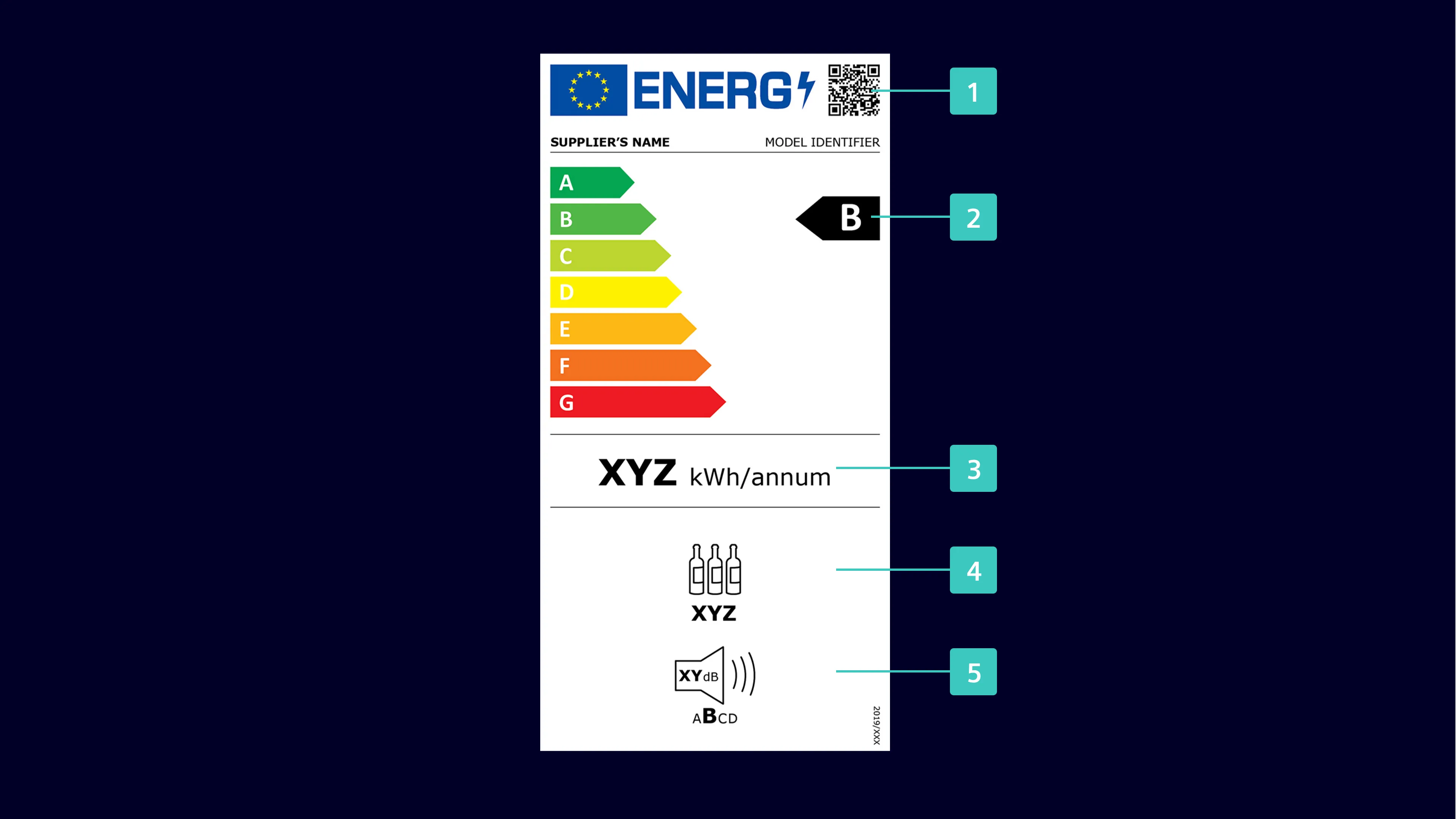
The energy label for wine coolers indicates the appliance's energy efficiency class. It also features a QR code, which provides access to more detailed product information. The label specifies the annual energy consumption, the number of standard wine bottles that can be stored, and includes information on the cooler's noise emissions and its designated noise emission class.
1 QR code
2 Energy efficiency class
3 Energy consumption in kWh/year (measured under new standard conditions)
4 Number of standard wine bottles that can be stored
5 Noise emissions expressed in dB(A) re 1 PW and noise emission class
Ovens
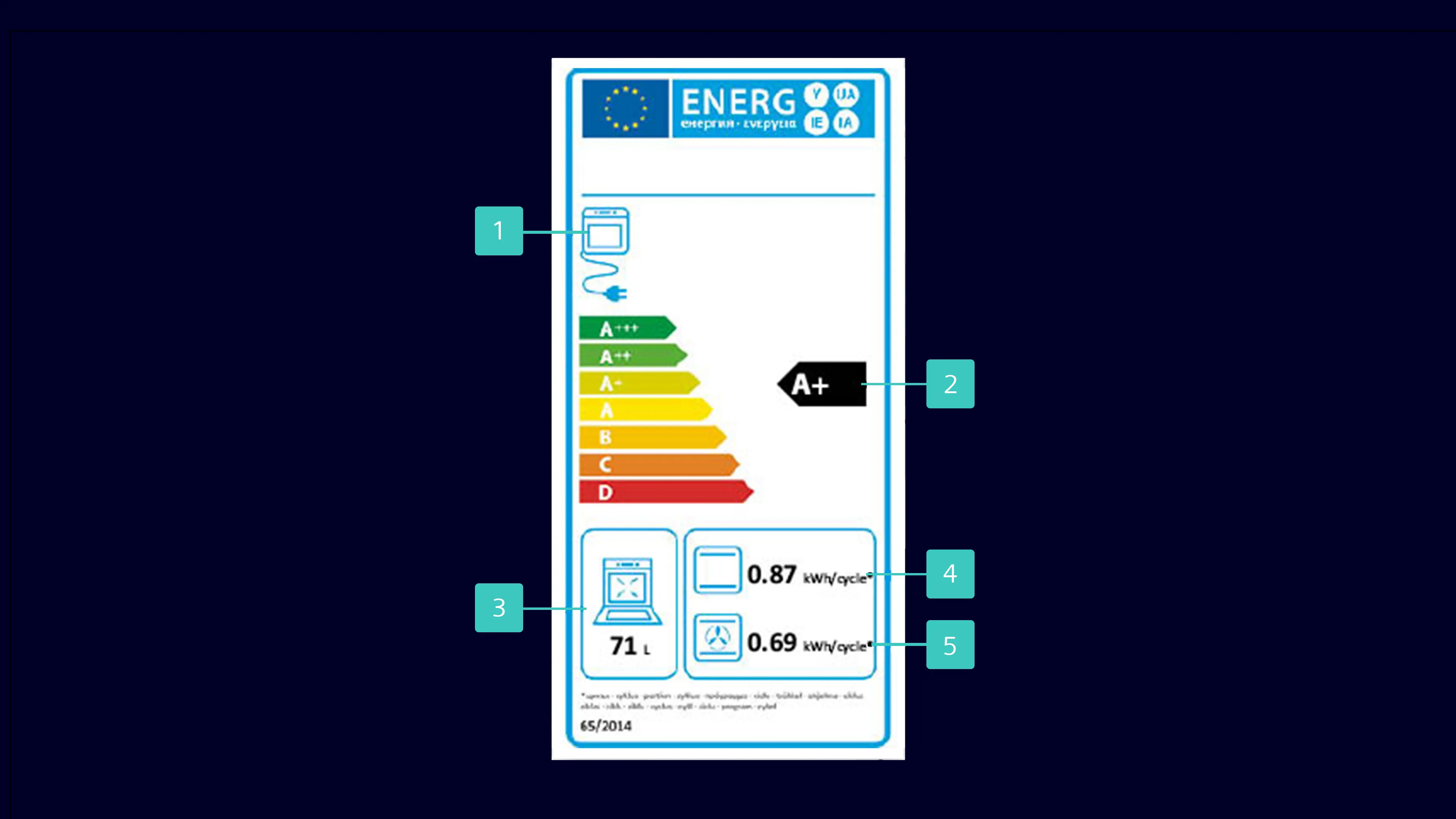
The Energy Label displays the energy consumption while baking in two different heating modes: with hotair or with top-/bottom heat. Beside the consumption, also the volume of the cavity is mentioned.
1 Energy efficiency class
2 Energy source: electricity
3 Cavity capacity
4 Energy consumption in kWh/cycle (top-/bottom heat)
5 Energy consumption in kWh/cycle (hotair)